A Ford Mustang Mach-E built for the US or Canadian market has a different charging inlet from the CCS2 stations used in Europe. With the right adapter you can charge it in Lithuania, Latvia and Estonia.
Which inlet your car has
Most 2021–2024 US and Canadian market Mustang Mach-E cars have a CCS1 (Combo 1) inlet. Newer models may have a NACS inlet, so look at your car’s inlet before buying an adapter.
DC fast charging
At a fast charger use a CCS2 → CCS1 adapter. The adapter’s rated power is not the car’s charging power: real speed depends on the car, the station and the battery’s state.
 CCS2 → CCS1 adapter 500 kW Original price was: 199,00 €.179,99 €Current price is: 179,99 €.In stock
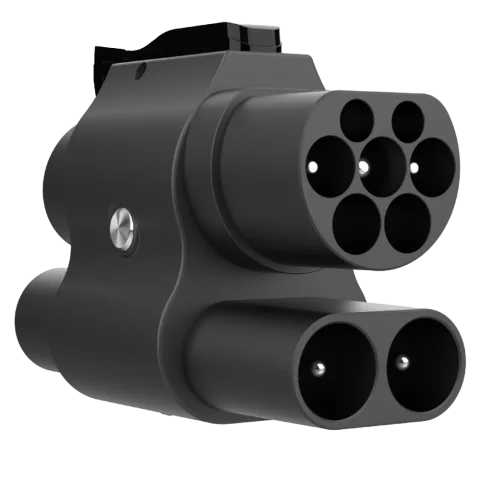 CCS2 → CCS1 adapter 250 kW129,99 €In stock
AC charging
At Type 2 AC stations and home chargers, charge through CCS2 → CCS1 adapters described as “AC + DC”. North American cars usually charge on AC with a single phase, so more slowly than European models.
Check before buying
- the car’s market and year (the inlet differs by market);
- whether the car has DC fast charging;
- the requirements in the chosen adapter’s description.
Which adapter version to choose
CCS2 → CCS1 adapters come in 250 kW and 500 kW versions. The 250 kW version suits most cars with lower fast-charging power, while the 500 kW version (up to 500 A and 1000 V) leaves headroom for more powerful cars, higher-voltage platforms and longer sessions without overheating. If in doubt, choose 500 kW – it will also suit another CCS1 car later.
How to charge at a station with an adapter
- Start the session with the operator’s app or card.
- Plug the adapter into the car first and make sure it has locked.
- Then plug the charger’s CCS2 cable into the adapter.
- Wait for the charger and the car to connect – with an adapter it can take a few seconds longer.
- When finished, stop the session first and only then unplug the cable and the adapter.
What charging speed to expect
The speed depends on the Ford Mustang Mach-E itself, the charger’s power, battery temperature and state of charge. A cold battery charges more slowly in winter, and above roughly 80 % most cars reduce power. The adapter’s rating (250 kW or 500 kW) is only an upper limit – an adapter does not make the car charge faster, it simply must not become the bottleneck.
Charging at home
Home chargers in Europe have a Type 2 connector. A US Ford Mustang Mach-E charges at home through a CCS2 → CCS1 adapter whose description lists both AC and DC charging. North American on-board chargers usually use one phase: about 3.7 kW at 16 A and 7.4 kW at 32 A. For overnight charging that is usually plenty.
Travelling in Lithuania, Latvia and Estonia
Fast chargers along the main roads in the Baltic states have a CCS2 cable, so always keep the adapter in the car. Before a trip, check the charger’s power and status in the operators’ apps. If a charger does not connect to the car through the adapter, try another unit at the same site.
Safe use
- check the contacts before every charge – they must be clean and dry;
- do not use a cracked or wet adapter, extension leads or chains of adapters;
- never unplug the adapter before the session has stopped;
- store the adapter somewhere dry, ideally in its case.
Questions about the Ford Mustang Mach-E
Can a Ford Mustang Mach-E use fast chargers in the Baltics?
Yes, with a CCS2 → CCS1 adapter, if the car has DC fast charging (two thick DC contacts at the bottom of the inlet).
Can the adapter damage the battery?
No. Charging is controlled by the car and the charger: the car itself states what voltage and current it can accept. The adapter only joins the different connectors and passes these signals on.
Will the adapter fit if I change cars?
It fits another car with the same inlet. If your new car has a different inlet you will need an adapter for that direction – you can return an item within 14 days.
Not sure? Send a photo of your car’s inlet and its details to info@ccs2.lt and we will help you choose. More in our guide to EVs imported from the US.